
Overview
Zenflow is a research-led product company, and the reason is structural: agency-grade creative AI is not a UX problem. The tools that exist today, whether canvases, node editors or single-model interfaces, solve the generation problem and call it done.
The actual problem is harder. It is persistent brand context across hundreds of generations, approval flows that compound into training data, deterministic retrieval over rich brand corpora, and orchestration across many models without losing the thread of who the brand is. Underneath all of it sits a question nobody has answered well: how do you guarantee that the parts of an asset which are not negotiable survive contact with a generative model? Each layer is its own research problem.
What follows is the standing agenda, then the one piece that has run end to end, then the questions we cannot answer yet.
Research areas
Multi-modal brand retrieval
A brand is not a colour palette. It is tens of thousands of visual artifacts accumulated over years, and standard retrieval is the wrong primitive for it: flattening documents into text chunks loses layout, typography, composition, and the relationship between a headline and its photograph. Our retrieval layer works on visual structure rather than text alone, so the question becomes which regions of which assets answer which parts of a brief. We are extending that into typed, weighted retrieval over a corpus that has a schema and explicit priorities, rather than fuzzy similarity.
Preference-based prompt optimization
Every approval, rejection and request for changes is a preference signal, and they accumulate into thousands per organization per year. Classical RLHF is the wrong lever for them, because we do not own the underlying models and weight-level gains expire at the next version. Optimising at the prompt layer applies across every model at once, costs inference rather than training, and keeps the resulting asset portable. The research problem is learning why one output was accepted and another was not, in a form specific enough to change the next generation.
Multi-model generation orchestration
No single model wins across formats, and the leader changes monthly. So the system picks rather than the user: a graph execution engine over a large model registry, routing on what the brand has historically approved, what needs the fewest revisions, and cost per successful asset. The hard part is heterogeneity. Different parameter spaces, prompt grammars, cost models and rate limits all have to sit behind one brand-aware intent.
From prompt layer to weight layer
Prompt optimization gives consistency across every model, while a per-brand fine-tune gives deeper consistency on one. They are complements, and past enough accumulated approved work the economics flip. The blocker is that multi-tenant fine-tuning is not a solved problem: one brand's intelligence must never inform another's, and the agency has to be able to audit that isolation. The relevant literature is federated learning rather than standard fine-tuning.
Closed-loop performance feedback
The only signal in the loop today is creative-director approval, which is sophisticated but expensive and slow. The richer signal is market response: which assets actually performed once shipped. The difficulty is weighting. Attribution windows differ per platform, engagement on a video is not comparable to engagement on a still, and a brand-equity brand that maximises weekly click-through erodes itself over a year. The reward function has to encode brand-side time horizons.
Brand compliance scoring
Whether an asset is on-brand should be answerable quickly, cheaply and explainably. Our first working version is deliberately not a model. It is an explicit rubric with fixed thresholds, wired into the repair loop in § 03, because the one component a brand's legal team may eventually need to read should not be a learned function. The research direction from there is multi-objective scoring with separate treatment of explicit constraints, implicit norms, and the tension between novelty and consistency.
Provenance and audit
Every asset needs a verifiable receipt: which model, which weights, which licence, which prompt, approved by whom, derived from which corpus. For agency holding companies that is a compliance requirement rather than a nice-to-have. The research question is how to construct verifiable provenance from imperfect inputs, given that models change weights silently, APIs are versioned inconsistently, and most providers expose no checksums at all.
The brand repair loop
A brand asset has parts that are negotiable and parts that are not. The lighting is negotiable. The spelling of the wordmark is not, and neither is the ambassador's face. Every image model in production treats all of it as negotiable, because it has no other mode: to edit an asset it encodes the pixels into a lossy latent, denoises toward something plausible, and decodes.
That round trip is where exactness dies, and it dies structurally. The encoder sheds high-frequency detail first, which is exactly the crisp edging that separates one letter from another. The denoiser optimises a texture objective, so nothing in it encodes that text is a sequence of discrete glyphs whose order has to be exact. The decoder then invents edges that look letter-like without being letters. Faces fail the same way. A face is a precise geometric relationship, made of eye spacing, jaw angle and cheekbone position, and those are high-frequency signals too. The model returns a plausible face, and plausible is not the specific person.
So no larger model fixes this, and any repair that stays inside the architecture inherits it. The answer has to be a loop wrapped around whatever generator you use.
Locate the defect, validate it against the brand kit without touching a pixel, repair only the region that failed, then re-run the same validators on the result and keep the repair only if it wins. Different failure classes need genuinely different repair engines: a wordmark is rigid and belongs to the brand, a face is deformable and has to be modelled, a product has to be reconstructed from reference. Collapsing all three into one inpainting model is how teams ship a pasted look.
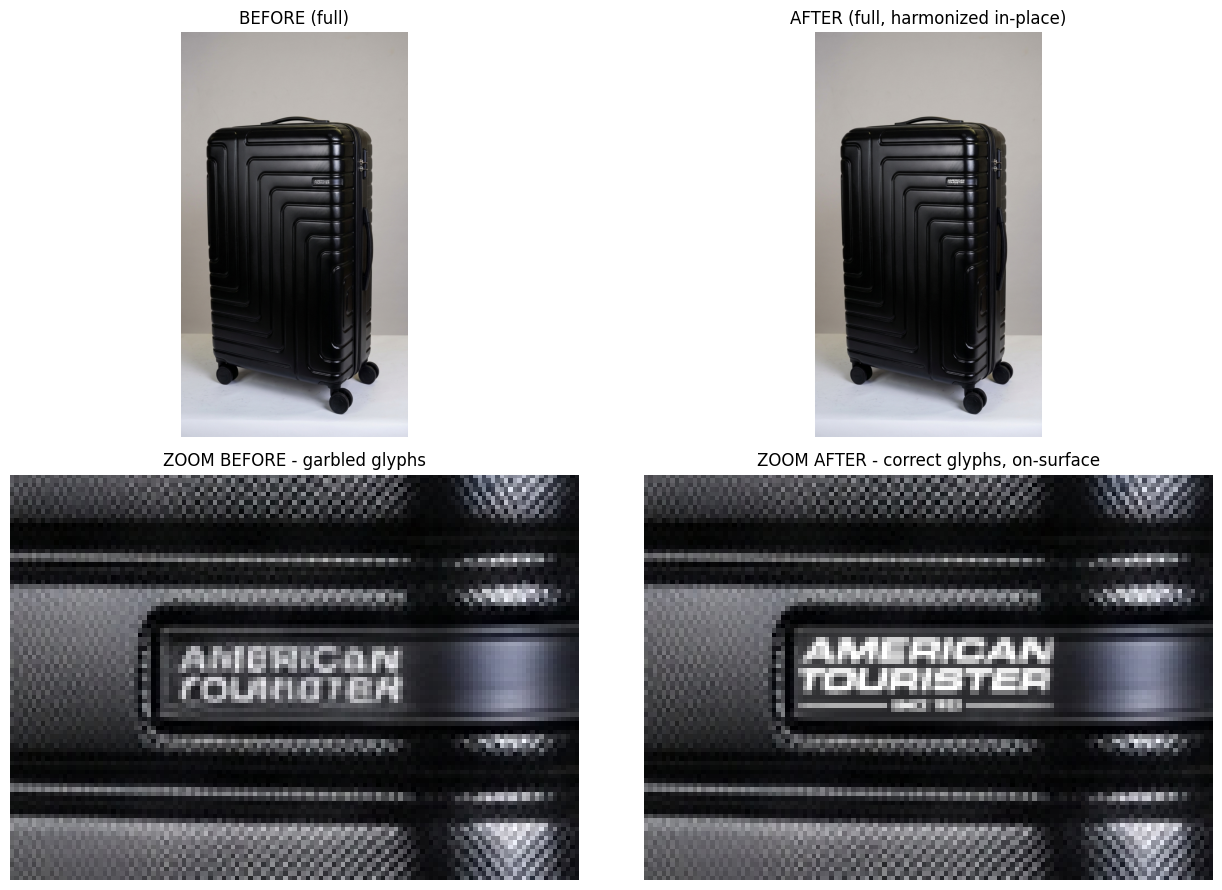
The repair stage is also gated against itself. On this image it proposed a blending refinement, measured what that refinement did to legibility, and rejected its own proposal. That is the same keep-only-if-better rule operating one level down.
The face case gave the more interesting result. Our identity validator scored the generated face above the gate and returned a pass, which in production means ship it untouched. Repairing it anyway moved it substantially closer to the reference identity, past the point where our scoring saturates. The gap between passing and being as good as the image can get turned out to be wider than the gap between passing and failing.
Either the gate is calibrated more loosely than brand work requires, or part of that improvement is the output drifting toward the average of the reference set rather than recovering the person, and both look identical on this meter. Telling them apart needs an evaluation set the meter has never seen.
Neither surprise was a repair problem. Both were about the thing that decides, which is the whole thesis: repair primitives commoditise, and a calibrated gate does not.
Most of the primitives this work depends on landed in the last two quarters, which is why it is worth doing now rather than a year ago.
- The bet got benchmarked. Recent editing benchmarks show that the best instruction-follower is the worst at region faithfulness, and that even the strongest in-region generator drifts unless it is confined.
- The loop became a published research object. Reference-guided consistency critics now exist in the literature, shipped as papers and datasets rather than as systems that answer to a brand kit.
- Deciding where to edit became first-class. Learned spatial gating separates what to change from where to change it, which is the missing primitive between detection and repair.
- Open-vocabulary segmentation got good enough to take the human out of detection, roughly doubling the prior state of the art and, with tracking, opening the same path for video.
- Identity was reframed as a trade-off rather than something to maximise, with the copy-paste failure mode now named and benchmarked instead of hand-waved.
- The pasted look got its own primitive, in the form of pixel-level compositing that returns untouched pixels and refines only the seam.
Our reading of it: the field has converged on confinement, which validates the architecture. What nothing published so far does is close the loop against a brand kit, gate on a calibrated identity meter, and carry provenance through the repair. That is the part we are building.
Open problems
Questions we do not have answers to. If any of them are your obsession, talk to us.
Where should an identity threshold sit for brand work? Our loop passed a face that a repair then measurably improved. Either the band inherited from general face recognition is too permissive for a contracted ambassador, or part of the improvement is regression toward the reference set, and both look identical on the meter. The general form of the question: how do you calibrate a gate on a corpus without calibrating it to that corpus?
What is the right schema for a brand corpus queried by both humans and generation models? It has to be expressive enough for typed retrieval and ergonomic enough for a creative director to maintain by hand. We do not think anyone has solved this.
What does pairwise preference data look like across brands in a multi-tenant system? Can a shared model learn which dimensions of brand identity predict approval, without ever sharing brand-specific values? This is the federated angle on preference learning, and the literature is thin.
When new models arrive monthly, how does a routing layer learn which to prefer without spending the brand's budget on exploration? There is a contextual-bandits framing here, but the prior art sits in ad routing and recommenders rather than creative generation.
How do you weight market signal against creative-director signal without overfitting to short-term performance? A brand-equity brand that maximises weekly engagement ends up with viral content that erodes equity over a year.
Can a compliance scorer transfer across brands, or does each need its own from scratch? We suspect partial transfer with brand-specific adaptation, but proving it needs data from many corpora, which is itself a multi-tenant access problem.
Reading list
A non-exhaustive set of work that has shaped how we think.
- Rombach, R. et al. (2022). High-Resolution Image Synthesis with Latent Diffusion Models. CVPR
- Deng, J. et al. (2019). ArcFace: Additive Angular Margin Loss for Deep Face Recognition. CVPR
- Chen, J. et al. (2023). TextDiffuser. NeurIPS · Tuo, Y. et al. (2024). AnyText. ICLR
- Pérez, P., Gangnet, M. & Blake, A. (2003). Poisson Image Editing. SIGGRAPH
- Kirillov, A. et al. (2023). Segment Anything. ICCV
- Sharma, G., Wu, W. & Dalal, E. (2005). The CIEDE2000 Color-Difference Formula. Color Research & Application
- Faysse, M. et al. (2024). ColPali: Efficient Document Retrieval with Vision Language Models
- Khattab, O. & Zaharia, M. (2020). ColBERT. SIGIR
- Lewis, P. et al. (2020). Retrieval-Augmented Generation for Knowledge-Intensive NLP. NeurIPS
- Ouyang, L. et al. (2022). Training Language Models to Follow Instructions with Human Feedback. NeurIPS
- Christiano, P. et al. (2017). Deep RL from Human Preferences. NeurIPS
- Rafailov, R. et al. (2023). Direct Preference Optimization. NeurIPS
- Xu, J. et al. (2023). ImageReward. NeurIPS · Wallace, B. et al. (2024). Diffusion Model Alignment Using DPO. CVPR
- Hu, E. et al. (2021). LoRA. ICLR · Ruiz, N. et al. (2023). DreamBooth. CVPR
- C2PA specifications and the Content Credentials initiative
Working with us
We are hiring a small, senior research team that ships into production. The bar is unusual: equally fluent in ML research and in the realities of agency creative work.
If you have worked at the intersection of multi-modal retrieval, preference learning or fine-tuning systems, and the open problems above feel like your problems, we would like to talk. We also run a structured collaboration programme with academic groups on the questions in § 04.
team@zenflow.media